
When looking at the Ashes scorelines since 2000, a fascinating pattern emerges.
The way Australia wins a series is fundamentally different from the way England wins one.
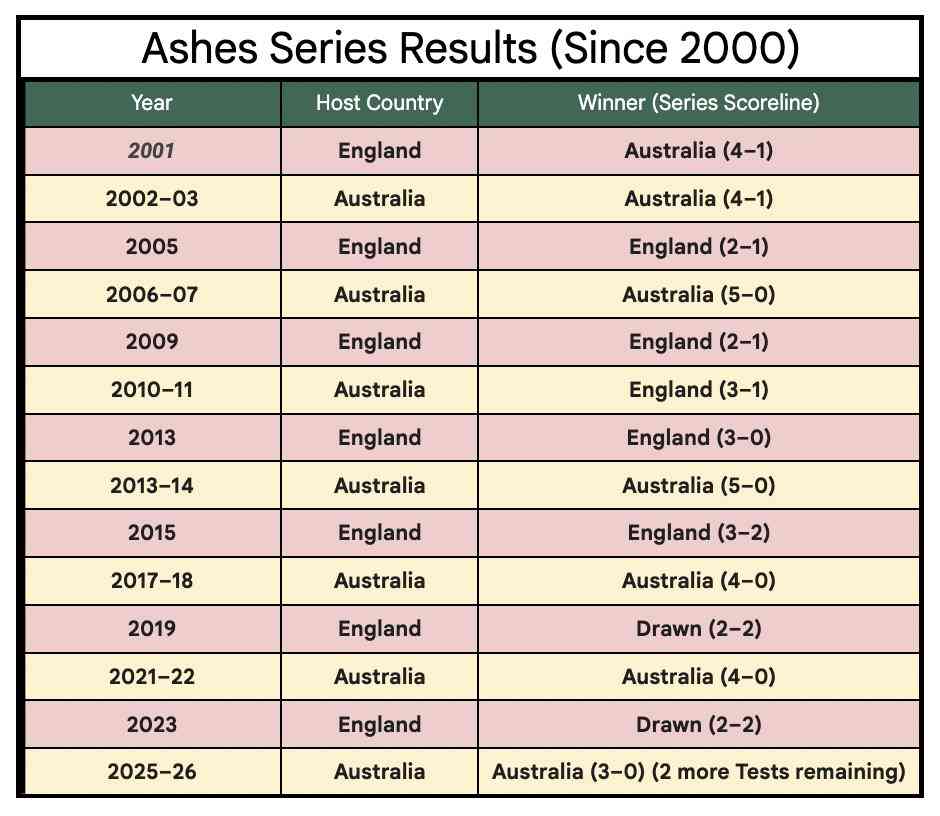
Victory Margins: Clinical vs. Contested
The Australian “Knockout” Model
In the 21st century, Australia has specialized in the “Ashes Sweep.” When they are on top, they don’t just win; they dismantle.
- Whitewashes (5–0): 2 (Australia in 2006–07 and 2013–14).
- Dominant Wins (4–0/4–1): 5 (Australia in 2001, 2002–03, 2017–18, 2021–22, and potentially the current 2025–26 series).
- Hard-Fought Wins (2–1/3–2): 4 (All England wins: 2005, 2009, 2013, 2015).
Australia has secured two 5-0 whitewashes (2006-07 and 2013-14) and four dominant wins of 4-0 or 4-1.
This dominance is built on relentlessness.
Australian conditions (hard, fast, and bouncy) allow their bowling attacks to psychologically “break” a visiting team. Once England loses the first two Tests in Australia, the momentum usually snowballs into a rout. The current 2025-26 series follows this exact script: a 3-0 lead secured before the Boxing Day Test even begins.
The English “Points Decision” Model
Conversely, England rarely “blows away” Australia. Instead, their victories are high-tension, seesaw battles that resemble a 12-round boxing match decided on points.
England’s greatest triumphs this century: 2005 (2-1), 2009 (2-1), 2013 (3-0), and 2015 (3-2). These were all decided by small margins in critical sessions.
English conditions (swing, seam, and unpredictable weather) tend to keep both teams in the game. Even when England is the better side, the nature of the pitches means a single Steve Smith century or a Mitchell Starc spell can flip a match. England wins through attrition and “clutch” moments, whereas Australia wins through sustained scoreboard pressure.
The “Away Win” Mirage – The Ashes Version
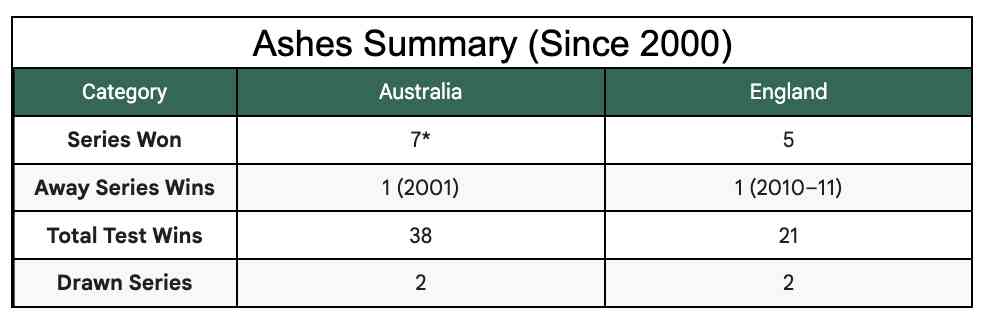
To understand how hard it is to win an Ashes series away, we must look at the only two times that happened in this century:
- Australia (2001): Arguably the greatest Test team in history (McGrath, Warne, Ponting, Waugh). It took a “Golden Generation” to win in England.
- England (2010-11): A team that hit a statistical peak, featuring three batters (Cook, Trott, Pietersen) who averaged over 60 during the tour. It took a once-in-a-lifetime run-scoring feat to breach the Australian fortress.
In 2019 and 2023, Australia didn’t actually win in England (both series ended 2–2). However, they celebrated as if they had because they were the holders.
The “Away Win” is no longer about being slightly better than your opponent; it requires being historic. Unless a team is significantly better than the other, the host’s natural advantages are now too great to overcome. And that is why India’s two back to back series wins in Australia is a historically rare achievement.
The Current Era: Australia’s Stranglehold (2017–2026)
The current Ashes series (2025–26) has not just been a victory for Australia; it has been the culmination of nearly a decade of dominance. By securing a 3–0 lead in Adelaide on December 21, 2025, Australia officially retained the Urn in record time—just 11 days of play.
This isn’t just a purple patch; it is a systemic “stranglehold” on the rivalry that began back in 2017.
Since reclaiming the Ashes with a 4–0 win in 2017–18, Australia has effectively locked the trophy cabinet and thrown away the key.
- 2017–18 (Home): Australia wins 4–0.
- 2019 (Away): Australia draws 2–2 (Retains Urn).
- 2021–22 (Home): Australia wins 4–0.+1
- 2023 (Away): Australia draws 2–2 (Retains Urn).
- 2025–26 (Home): Australia leads 3–0 (Retained Urn)
With the latest results, Australia will have held the Ashes for eight consecutive years. For an entire generation of young fans, the Urn being in English hands is a historical concept, not a lived memory.
It has now been over 5,400 days since England last won a Test match in Australia (January 2011). In sports, that isn’t just a losing streak—it’s a generation of dominance
Final Thought: Is the Rivalry at Risk?
The Ashes remains the pinnacle of Test cricket, but as our 25-year analysis shows, the competitive gap between host and visitor is widening. Since 2001, Australia has won nearly twice as many Test matches as England (38 vs. 21).
History and tradition provide the oxygen for this rivalry, but for the Ashes to maintain its status as the world’s greatest sporting contest, the “Away Win” must return from the verge of extinction. Until then, the Urn remains firmly under Australian lock and key, guarded by a home-soil advantage that has become the most formidable force in the game.


