IPL 2026 already feels decided long before the first ball is bowled. The auction made one thing clear: franchises are no longer chasing familiar names or nostalgic appeal. Instead, they are backing youth, multi-skill players, and tightly defined roles, guided by data rather than reputation. This season’s real contest isn’t about who landed the biggest star, but whose model can survive 14 league games and deliver when the knockouts expose every flaw.
Breaking Down the IPL 2026 Auction Spend Pattern
A quick snapshot of the auction reveals a clear strategic shift:
- Teams spent ₹215.45 crore on 77 players, using the mini-auction as a quiet squad reset rather than a star chase.
- Overseas players absorbed ₹128.05 crore across 29 signings, while 48 Indian players accounted for ₹87.40 crore, showing a value gap in spending.
- Just 9 capped Indian players were bought, with 6 going at base price, 5 of them for only ₹75 lakh, underlining limited demand for experience.
- 32 players picked were under 25, including 29 Indians, reinforcing how heavily franchises leaned into domestic youth development.
When Age Became a Liability at the IPL 2026 Auction
The age data reads like a warning to veterans: either reinvent, or get ready to be a mentor, not a millionaire.
- Of the 77 players bought, 32 were under 25, while 20 were aged 30 or above.
- Among Indian players over 30, just 3 managed to sell for at least twice their base price, highlighting shrinking upside for veterans.
- Uncapped teenagers Kartik Sharma (19) and Prashant Veer (20) drew identical ₹14.2 crore bids from CSK, setting a new benchmark for uncapped players in IPL history.
Overseas veterans, particularly those aged 30+, faced muted demand or went unsold as franchises leaned towards younger all-rounders and express pace options.
The Three Lanes That Will Shape IPL 2026
Look at who got big money, and you see one equation:
Cameron Green to KKR (₹25.20 crore): Combines top-order hitting, seam bowling, and elite fielding. A rare all-phase contributor who impacts powerplay, middle overs, and chases.
Matheesha Pathirana to KKR (₹18 crore): A specialist death-overs solution. Addresses KKR’s long-term issue of leaking runs in overs 16 to 20 with a proven closer.
CSK’s approach: Investment in young all-rounders plus adaptable overseas seam and spin options suggests an attempt to internally develop Green-style multi-skill profiles rather than buying one outright.
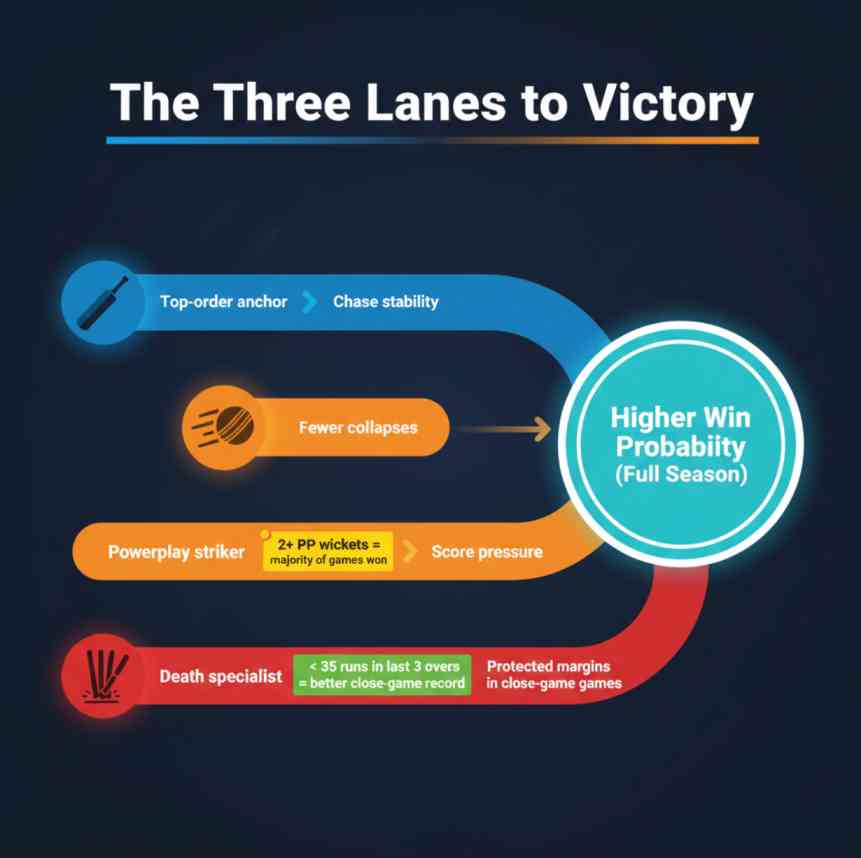
These signings feed directly into your “Three Lanes to Victory” model:
- Lane 1 – Top-order anchor
Stabilises innings, limits collapses, and controls chase tempo.
- Lane 2 – Powerplay strike bowler
Seamers or mystery spinners targeting two or more wickets inside six overs, a metric historically tied to higher win probability.
- Lane 3 – Death-overs specialist
Bowlers who control overs 18 to 20 and prevent 20+ run explosions—often the difference in tight finishes.
Who Looks Like a Finalist On Paper?
This is where the data story becomes a prediction game. Going by squad structure, role coverage, and auction efficiency, four teams stand slightly ahead in the 2026 race.
| Team | What the auction fixed | Key risks | Early finals probability (on paper) |
|---|---|---|---|
| KKR | Filled elite all-rounder slot (Green), solved death overs (Pathirana), added WK-openers (Seifert, Allen), and bowling depth. | Over-reliance on Green’s fitness and adaptation; Pathirana handling big-game pressure. | Very high – most balanced XI and bench. |
| RCB | Extracted huge value with a small purse; Venkatesh Iyer at ₹7 cr, Jordan Cox at base, Duffy as pace backup. | Pace fitness (Hazlewood), death overs still not bulletproof, dependency on the top 3 batting. | High – defending champions with smarter depth. |
| DC | Strengthened batting/finishing around an already strong core; looks “complete” on paper across roles. | Need consistency from the younger Indian core; overseas balance at Kotla-like pitches. | High – strong league-phase side, question mark in knockouts. |
| CSK | Massive youth injection with Kartik & Veer, smart overseas picks for Chepauk conditions. | Inexperience in middle order and bowling, especially under pressure; transition away from “old CSK” identity. | Medium-high – boom-or-bust; if kids click, dark-horse finalists. |
These probabilities are “on-paper” reads, not numeric models, but they track with most expert ranking lists post-auction, which consistently place KKR and RCB in the top 2 to 3, with DC and CSK in the chasing pack.
What to Watch for When Ipl 2026 Starts
As the discussion about IPL 2026 begins, the real story goes beyond results to whether auction logic holds up on the field. KKR’s season may hinge on whether the Green–Pathirana pairing can tilt three or four tight games, while CSK’s playoff hopes rest on Kartik Sharma and Prashant Veer delivering 250-plus runs or double-digit wickets.
League-wide, the season will reveal whether powerplay wickets matter more than late-over bursts and if uncapped Indian crorepatis truly offer better value than mid-tier overseas names. For credibility, the above IPL facts and records about the mini auction were verified the GrabOn team, grounding this data-led assessment. Ultimately, IPL 2026 tests structure over stardom.